
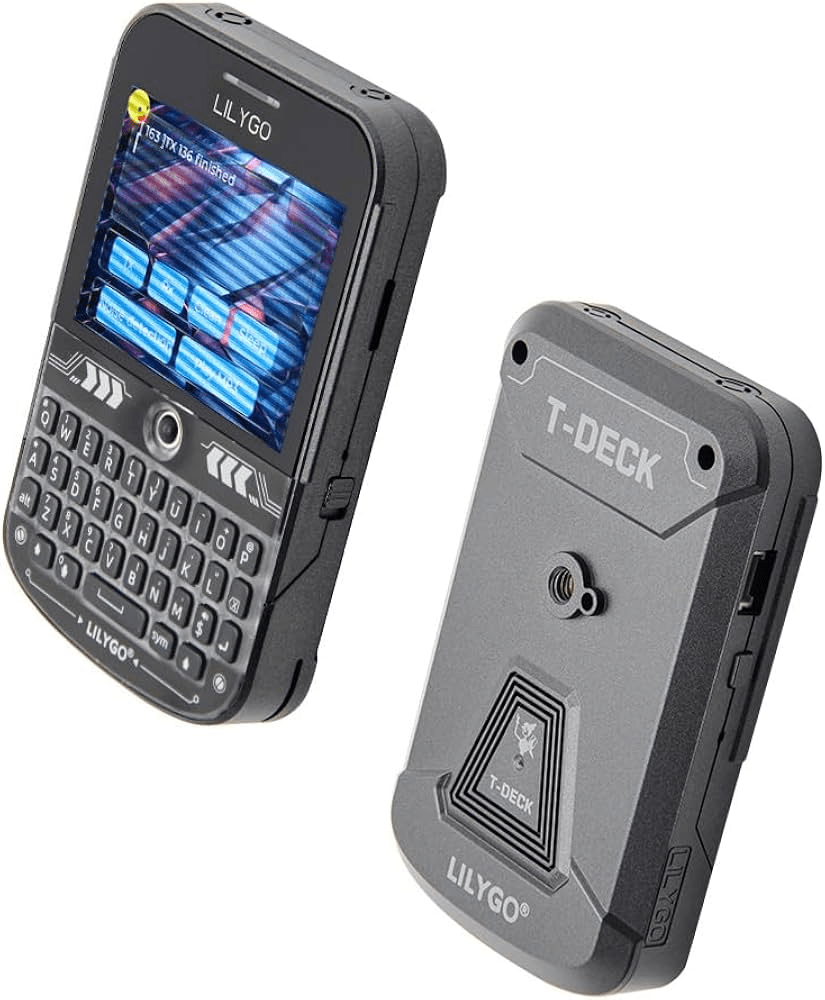
LILYGO T-Deck Plus with Meshcore

The challenge with mesh networks such as MeshCore, Meshtastic, or similar systems is that a phone is still the most practical device for reading information, sending messages, and typing on a keyboard. However, the phone also needs to be connected to a node that can act as the bridge to the LoRa network. In practice, this means carrying several devices, which is not always convenient.

That is why I wanted to test the LILYGO T-Deck Plus. It is a LoRa device with the useful addition of a built-in screen and keyboard. This makes it possible to have a standalone device for communicating on these networks, and it should make mobile testing much easier.

I tried one, and in this post I will share the different steps I followed to get it working.

Continue reading

Install UniFi-controller on Raspberry-Pi

UniFi is a really good brand from Ubiquiti for network equipment (no sponsorship, just my feeling) in particular for home and small businesses. It comes with a controller to manage the whole network. This controller can be deployed on a small computer like raspberry Pi. It runs mongoDB, Java, so I recommend to use a PI4.

I was running a UniFi controller on my RPI4 since a while… But I had the wrong idea to apt-get upgrade the system and it crashed… Why ? Mostly because the controller distribution is a bit a mess with the MogoDB version and the 32b / 64b, but at the end you’re stuck.

So I’ll describe here how to install the controller in a proper way with docker.

Continue reading

Migrate Helium Miner hardware

Helium is a crowdsourced / blockchain IoT network running on hardware like raspberryPi. You can more details on this blog post describing Helium network. Sometime you can have to move you miner from one hardware to another and this task needs to be executed shortly because you stop the IoT communication during this step. Here how I did proceed for my miner.

Continue reading

Getting started with GNURadio & scapy

GNURadio is an open-source software for making Software Defined Radio. It can be used to model a radio transmission or the process a real radio communication.

Scapy is a python tool set able to interact with GNURadio. Basically GNURadio will receive an signal from a SDR key and process it to get a digital sequence. Scapy will process this sequence and potentially generate a new sequence to be process by GNURadio to be transmitted.

There are plenty of example of GNURadio/Scappy usage to hack, simulate, learn many radio protocols like WiFi, GSM, Bluetooth… I want to play a little with Sigfox also so that’s why I started to investigate on this tool.

As this tool is a bit complicated, this post details the key element having helped me to getting started with this tool.

Continue reading

Centos 7 – firewall-cmd usefull commands

A short post to save some of the useful options for firewall-cmd:

Continue reading

LoRa Wan in a rural environment

Lora-300x171After making LoRaWan test in a city environment, I make some test in a rural environment with the objective of evaluating the capability for being used in connected farming environment.

The result is really like what we have got in a city, eventually better in a way as the antenna position was on altitude. The following map makes with 6kbps communication shows the coverage. You can see that the coverage is really limited on the Eastern direction. This is due to higher mountains this way. Mountain are the main limiting elements and as you can see, even on short distance communication they are blocking any signal.

Read more to access the map.

Continue reading

LoRa / TheThingNetwork – Install you own backend

In a try to connect my LoRa gateway to a standard backend, I started to install TheThingsNetwork software stack. Even if I did not finish it because it was not compatible to my gateway protocol, here are my starting notes … May be completed later.


Continue reading

First step in LoRa land – microchip RN2483 test

Microchip RN2483 Lora

Microchip RN2483 Lora

After spending some time reading and writing about LoRa it was a good time to make some real test of this technology.

As actually there is no network for LoRa, as much as I know, in my town, I expected to start a simple LoRa test (point to point and not as part of a WAN). I just bought some RN2483 LoRa module from Microchip online and also get some from Avnet (thank you Guillaume)


The module is easy to solder on a prototype board and get its command over a serial port. I choose to make two modules :

  • The first one is connected to a FTDI cable and will stay at home as a basestation
  • The second one is connected to an Arduino and will be a mobile device for my test

Continue reading