
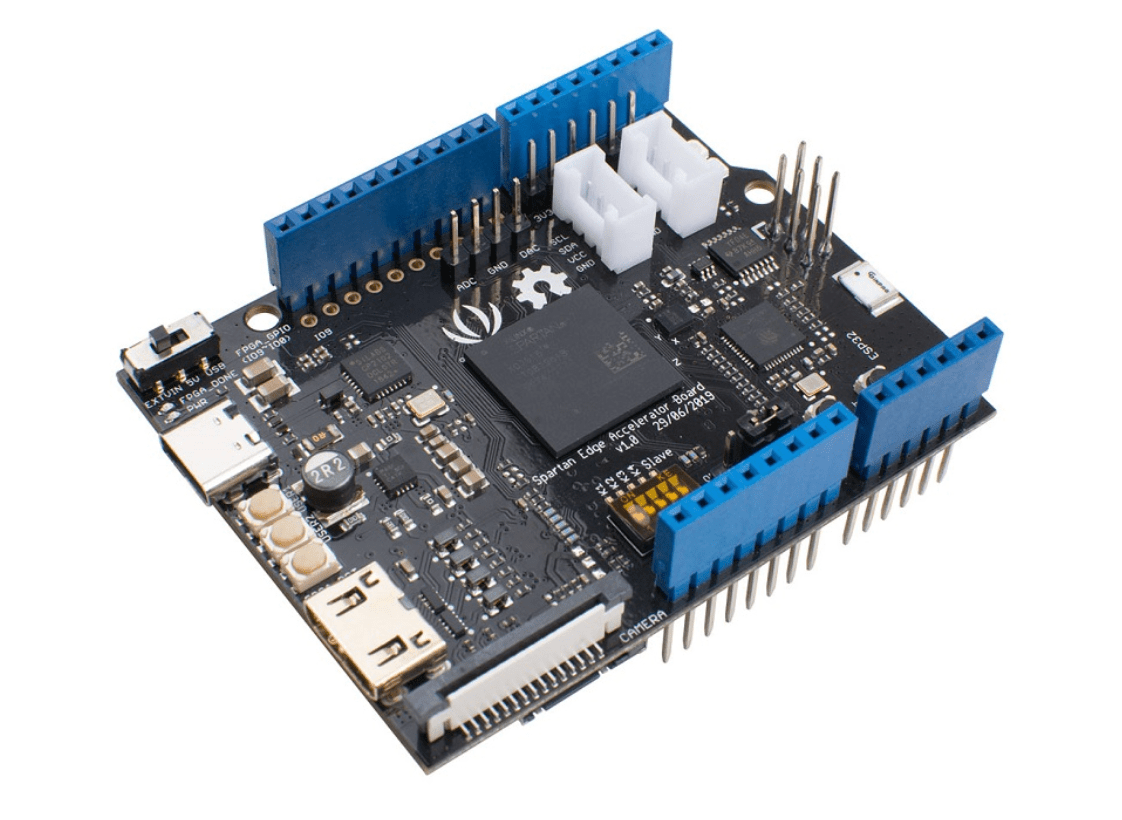
Seeed Spartan Edge Accelerator Board, low cost FPGA

About 20 years ago, I started working on the design of a microprocessor. The goal was mostly to have fun building a small 32-bit RISC CPU, make it open source, and, most importantly, explain the process behind it. I abandoned the project roughly 18 years ago as I moved on to other things.

This year, I want to bring the project back. Processor design was something we used to learn in univerity at the time, but today it has become much more abstract. Even understanding what actually happens inside a processor is now often treated as a fairly distant concept.

That old work is a good foundation for explaining these ideas again. For that reason, I wanted to refresh the hardware I used years ago to build the processor, which was based on an FPGA that I will discuss in more detail later. Because this is relatively professional hardware, access to FPGA development kits is usually quite expensive. And while it was honestly worth the investment, Seeed Studio has since created a development kit looking like an Arduino, includes an ESP32, and remains much more accessible. It integrates a Xilinx Spartan FPGA. It is not one of the high-end models, but it is still roughly ten times larger than the one I was using around 20 years ago, which makes it a very good fit for this project.

Continue reading

TheThingsConference 2024

On September 25th and 26th, the new edition of TheThingsConference was held, the must-attend event of the LoRaWAN ecosystem and, more broadly, LPWAN. Even though the event, which was very open, is naturally becoming increasingly focused on TheThingsIndustrie’s solution and thus LoRaWAN, it remains an opportunity for numerous discussions in many other areas.

The organization was, as always, perfect, with ample space for side events that provide great opportunities for networking.

There were few announcements this year beyond the arrival of TheThingsIndustrie’s “plug & play” gateway and the introduction of trackers in the form of solar-powered tags, which seem to confirm the trend of IoT in this form factor, following RAK Sodaq and many other ongoing projects.

Continue reading

News from LoRaWAN Live Munich

This week saw the Munich edition of LoRaWAN Live, the event for the LoRaWAN community organized by the LoRa Alliance. This event rotates locations with each iteration, and this edition marked the return of the event to Europe.

As usual, the event was a professional gathering for alliance members who use these events to advance the evolution of the LoRaWAN standard. Participants included gateway manufacturers, device makers, and electronic component producers. Unfortunately, this focus, often comes at the expense, of non-member users and smaller players, who are less present compared to events like The Things Conference or larger, more general conferences, like IoT Solutions.

The main downside of this conference, in my opinion, was the low attendance of end users and newcomers. This is likely due to the high cost of attending the conference, not to mention the hotel prices during the Euro 2024 period.

Despite this, the conference featured a series of high-quality presentations on the development of use cases, market growth, and opportunities for in-depth discussions with technology experts. As always, it was a chance to meet new people and have engaging conversations.

So, what’s the state of the LoRaWAN ecosystem in 2024?

Continue reading

SenseCAP T1000-A tracker

SenseCAP (Seeedstudio) has launched a Kickstarter campaign for launching it new LoRaWan product, a tracker based on LR1110 Semtech transceiver. This Kickstarter is a bit unusual as the product is already designed and operational. It’s more a way to have a minimum of order to initiate a production batch with a guaranteed volume.

This tracker exists in different version with different capabilities and sensors. The version I received for testing it is a T1000-A, able to get outdoor position with GNSS, indoor position with WiFi, temperature, light and accelerometer data.

Continue reading